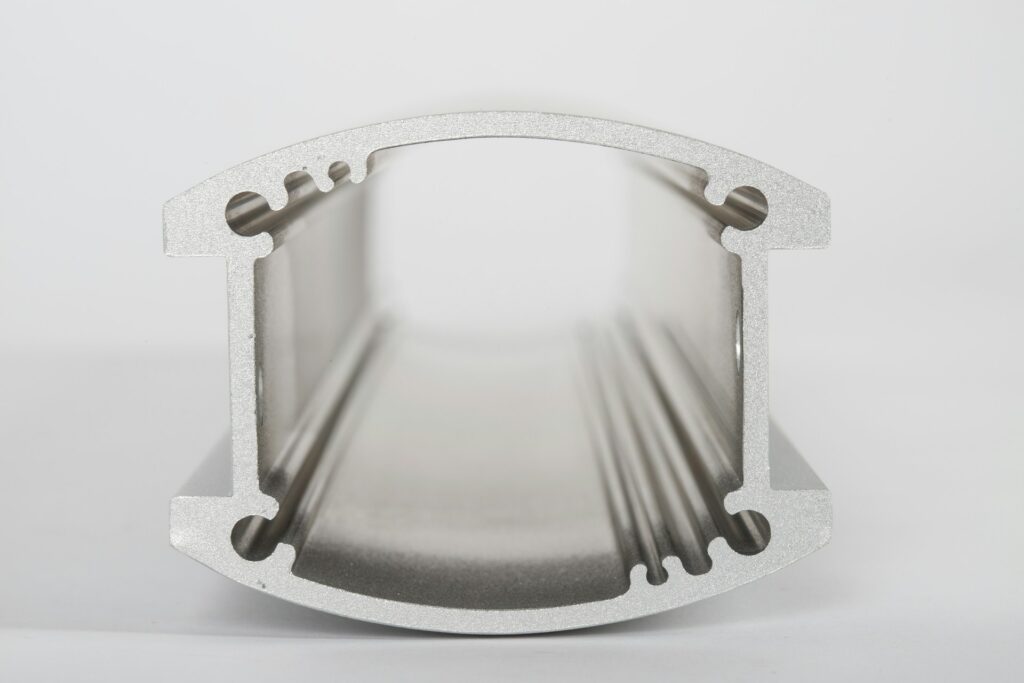
Recycled aluminium extrusion scrap serves as a highly valuable secondary raw material across Europe. This material is incredibly clean and chemically predictable. It also returns to the melting process in large, clearly defined batches. Yet, a massive amount of this scrap still leaves the continent or ends up in low-quality alloys. During 2025, the EU exported approximately 1.27 million tonnes of aluminium scrap. Roughly 30 percent of that volume travelled to India. At the exact same time, about 15 percent of European recycling capacity sat completely unused.
This comprehensive guide explores the true potential of recycled aluminium extrusion scrap. It also examines what the EU is doing to improve circularity. Finally, it explains how the APT Platform uses smart AI tools to connect this material with the perfect buyer.
Most extrusion scrap belongs to the 6xxx alloy family. You will typically see grades like 6060, 6063, 6005, or 6082. These specific alloys contain very small amounts of magnesium and silicon. As a result, clean profile scrap consistently offers between 97 and 99 percent pure aluminium.
The true commercial value relies on what the material does not contain. Alloys like 6060 and 6063 tolerate very little manganese. The acceptable limit normally stays under 0.10 percent. Furthermore, iron and copper limits remain exceptionally strict. For example, a single batch of 2xxx profiles might carry up to 5 percent copper. Introducing that mistake can easily push an entire furnace charge out of specification.
Therefore, the main commercial decision is very straightforward. Does a specific batch stay inside the high-value 6xxx loop? Or does a facility dilute it into a cheaper casting alloy? Remelting aluminium only requires about 5 percent of the energy needed to produce primary metal. Consequently, the environmental benefits remain massive either way. However, the true economic value depends entirely on proven purity.
The sheer scale of this material stream is also vital. Recycled sources now provide roughly 40 percent of all aluminium consumed in Europe. This equates to nearly 5 million tonnes every single year. Over the past decade, European recyclers invested around 700 million euros in furnace and plant upgrades. These investments added roughly 1 million tonnes of annual processing capacity. Today, much of that new capacity competes for the exact same clean profile scrap. Because of this high demand, precise sorting accuracy and flawless documentation decide who ultimately wins the material.
The most profitable route sends clean scrap straight back into extrusion billet. Extruders already manage this perfectly with their own internal offcuts, butt ends, and rejected profiles. Post-consumer profiles from old windows, doors, and curtain walls can easily follow this identical path. Operators simply need to remove all coatings, thermal breaks, and steel fixings first.
Buyers in this specific market segment demand three critical things. They require total alloy consistency, minimal iron pickup, and a fully traceable origin. These facilities generally accept anodised material without issue. However, commercial contracts usually cap painted material at roughly 10 percent of any given load.
Window frames, sliding systems, solar shading, and curtain wall profiles represent the largest single market outlet. Demand within this sector continues to grow rapidly. Today, architects and public buyers actively demand exact recycled content figures in their project tenders. Furthermore, the revised Construction Products Regulation introduces strict environmental declarations alongside a digital product passport. Consequently, recycled content will soon transition from a simple marketing claim into a legally documented figure.
Extruded 6xxx profiles act as structural backbones for crash systems, battery enclosure frames, roof rails, and seat rails. Automotive buyers enforce extremely narrow chemistry windows. They also demand comprehensive batch documentation. Therefore, any scrap batch that can definitively prove its alloy chemistry and history will earn a significant price premium in this sector.
Mounting rails for photovoltaic panels, LED heat sinks, conveyor frames, and pneumatic profiles absorb enormous scrap volumes. The engineering tolerances here are much less severe than in automotive applications. As a result, this sector provides a highly practical destination for mixed but properly sorted 6xxx material.
Mixed, coated, or heavily contaminated profile scrap still holds commercial value. Facilities routinely convert this material into secondary casting alloys or use it for steel deoxidation. This route serves as a perfectly legitimate market outlet. However, it represents a permanent one-way step. Once pure aluminium enters a mixed casting alloy, it can never return to the high-value extrusion loop.
European policy has evolved incredibly fast regarding secondary materials. Several major regulatory files will activate during 2026.
Aluminium Scrap Export Measures. The Commission officially announced its work on scrap leakage back in November 2025. Following that, they established a customs surveillance system for metal scrap flows in mid-2025. The final proposal schedule recently slipped from the spring timeline to 9 September 2026. Early reporting strongly points toward a new export tariff of around 15 percent. Naturally, the industry remains deeply split on this topic. European Aluminium actively supports these trade restrictions. Conversely, recycling federations argue that Europe already generates more secondary aluminium than local industry consumes.
The Circular Economy Act. Lawmakers expect to publish this proposal in the second half of 2026. Its primary objective is creating a unified single market for secondary raw materials. The legislation promises to deliver a better supply of high-quality recyclate and stimulate stronger internal EU demand. Overall, the Commission wants to double the circular material use rate to 24 percent by 2030. For context, this rate sat at just 11.8 percent in 2023.
The Waste Shipment Regulation. Regulation (EU) 2024/1157 officially applies from May 2026 for most shipping procedures. Furthermore, exports of waste for recovery to non-OECD countries will face significantly tighter restrictions starting in 2027. These new rules will mandate rigorous physical audits of all receiving facilities.
Ecodesign and Product Passports. The Ecodesign for Sustainable Products Regulation specifically targets aluminium as a priority intermediate product. Soon, mandatory digital product passports will carry verified recycled content data and material composition details across the entire supply chain.
Carbon Border Adjustment Mechanism (CBAM). CBAM entered its definitive operational phase in 2026, and it directly regulates aluminium imports. Embodied carbon now carries a tangible financial price at the European border. This structural change inherently boosts the market value of low-carbon secondary metal.
Our dedicated circular policy overview closely tracks how these regulatory files impact daily trading decisions.
APT was specifically engineered to solve this exact market friction. You possess high-quality material, but you lack a clear specification. Meanwhile, a buyer somewhere in Europe desperately needs it but cannot locate it.
Our Computer Vision Engine accurately classifies material directly at the scrapyard. The software instantly identifies profile geometry. It perfectly separates coated aluminium from mill finish metal. Additionally, it actively flags attached steel or plastic parts and estimates the exact volume of foreign material. Instead of relying on a subjective manual grade, operators secure a highly repeatable digital assessment with clear photographic evidence. This irrefutable record fully supports your commercial claim to the buyer.
The Digital Material Passport centralizes all crucial data into one secure record. It stores alloy chemistry, laboratory analysis, coating types, geographical origin, processing history, and physical photographs. This system maps seamlessly onto standard EN 13920 scrap descriptions. It also completely satisfies the upcoming data requirements for ESPR and the Construction Products Regulation. Consequently, when a façade extruder demands solid proof of recycled content, your verified answer is already prepared.
Our Matching Module compares your newly passported batch against live buyer requirements across the entire continent. The system rapidly analyzes chemistry limits, coating tolerances, available volumes, packaging methods, and geographic locations. Then, it ranks the most realistic commercial counterparties. A batch that a standard trader might label as generic extrusion scrap can suddenly emerge as a flawless fit for one billet caster in Belgium and two others in Germany.
The Optimisation module intelligently manages charge composition and freight logistics simultaneously. It precisely calculates how much of a marginal scrap batch a specific furnace can safely absorb. It does this without ever breaking strict iron or manganese limits. Furthermore, it compares real-time transport options. This ensures that a small premium in the final metal price is not instantly destroyed by expensive freight costs. You can explore deeper details regarding our AI capabilities on the primary module page.
Administrative Document Automation seamlessly prepares your complex shipment documents, waste classifications, and compliance declarations straight from the passport data. Because the Waste Shipment Regulation is now actively in force, this automation drastically reduces your risk of a rejected consignment. Our policy pages clearly explain exactly which legal documents apply to every specific transport route.
The following practical examples are illustrative scenarios rather than specific client accounts.
A demolition contractor in Rotterdam removes 62 tonnes of old window frames from a 1990s commercial office block. These profiles still contain polyamide thermal breaks, thick glazing gaskets, and embedded steel screws. Local scrap traders only offer a very low price for the mixed load.
First, the contractor photographs the material using the Computer Vision Engine. The AI software successfully separates the dominant 6060 frames from a much smaller batch of 6063 sliding sections. It also correctly flags the thermal break content at approximately 4 percent by total weight. After completing a mechanical shear and separation step, the Digital Material Passport securely records the newly cleaned fraction. Next, the Matching Module identifies a highly specific billet caster located in North Rhine-Westphalia. This particular buyer readily accepts anodised 6060 with limited paint contamination. Ultimately, the contractor successfully sells 54 tonnes back into the lucrative extrusion loop rather than downgrading it into a cheap casting alloy.
A Portuguese extruder consistently generates butt ends, offcuts, and roughly 900 tonnes of loose machining chips every year. These tiny chips oxidize very easily. Previously, the company always sold them at a discount to a casting alloy buyer.
The extruder decides to deploy the Optimisation module to effectively model a new briquetting and remelt scenario. The system compares this new scenario directly against their own internal billet demand. The model clearly proves that these internal chips can safely cover a portion of the furnace charge, provided that iron pickup remains tightly controlled. The passport records then automatically generate the exact recycled content figure. The company successfully reports this verified data to its façade customers to satisfy the Construction Products Regulation. Because documentation is generated automatically, the sustainability team completely stops wasting time rebuilding complex spreadsheets every single quarter.
A major trader based in Antwerp currently holds 400 tonnes of heavily painted and anodised profile scrap. The company originally planned to ship this entire volume to buyers in Asia. However, with new export measures actively under discussion, the profit margin suddenly looks extremely fragile.
To solve this, the trader passports the entire stock and processes it through the Matching Module. The system quickly discovers two solar mounting profile producers and one industrial framing extruder operating inside the EU. Next, the Optimisation module intelligently splits the large lot into three distinct batches. This strategy ensures that each individual buyer receives a custom blend that perfectly respects their specific paint tolerance limits. Ultimately, the trader keeps all the material within Europe while securing a comparable net margin. Additionally, our circular policy tracker automatically flags every required compliance document for each specific domestic route.
You should start by fully leveraging the data you already possess. Grade your extrusion streams properly, record exactly what you discover, and permanently attach that evidence to the physical batch. Purity that you cannot definitively prove is purity that you simply cannot sell.
If you handle profile scrap in high volumes, our AI modules and material passport tools offer a highly logical place to begin your digital transition. Book a personalised walkthrough on the APT Platform website, and we will happily analyse one of your real material streams together.