Lead is one of the most widely used metals in the world. It is also one of the most toxic. This creates a unique challenge for industrial companies. We must use lead for vital applications, but we must also protect human health and the environment. The solution lies in the circular economy. Recycling lead scrap is highly effective. In fact, lead can be recycled infinitely without losing its quality.
Today, secondary lead materials dominate the market. However, managing this toxic waste requires strict compliance and precise tracking. Companies need advanced tools to handle the complexities of lead recycling. This is where artificial intelligence steps in. AI-powered tools for circularity companies make it easier to track, sort, and optimize lead scrap. In this post, we will explore the applications of recycled lead. We will also discuss European Union regulations and see how modern software transforms toxic waste management.
Recycling lead is a global priority. Mining raw lead consumes vast amounts of energy. It also causes significant environmental damage. By recycling existing lead, we save energy and reduce harmful emissions. The recycling process involves collecting scrap, crushing it, and smelting it in furnaces. The resulting secondary lead is just as pure as newly mined lead.
This high recycling rate is not just good for nature. It is also essential for industry. The demand for reliable energy storage continues to grow. Lead remains a core component in many sectors. Therefore, maintaining a steady supply of recycled lead scrap is vital. Companies must secure their supply chains. They can achieve this by using supply chain optimisation tools to ensure consistent material flow.
Recycled lead finds its way into many different products. Its unique properties make it impossible to replace in certain fields. Lead is dense, malleable, and highly resistant to corrosion. Let us look at the primary applications for secondary lead materials.
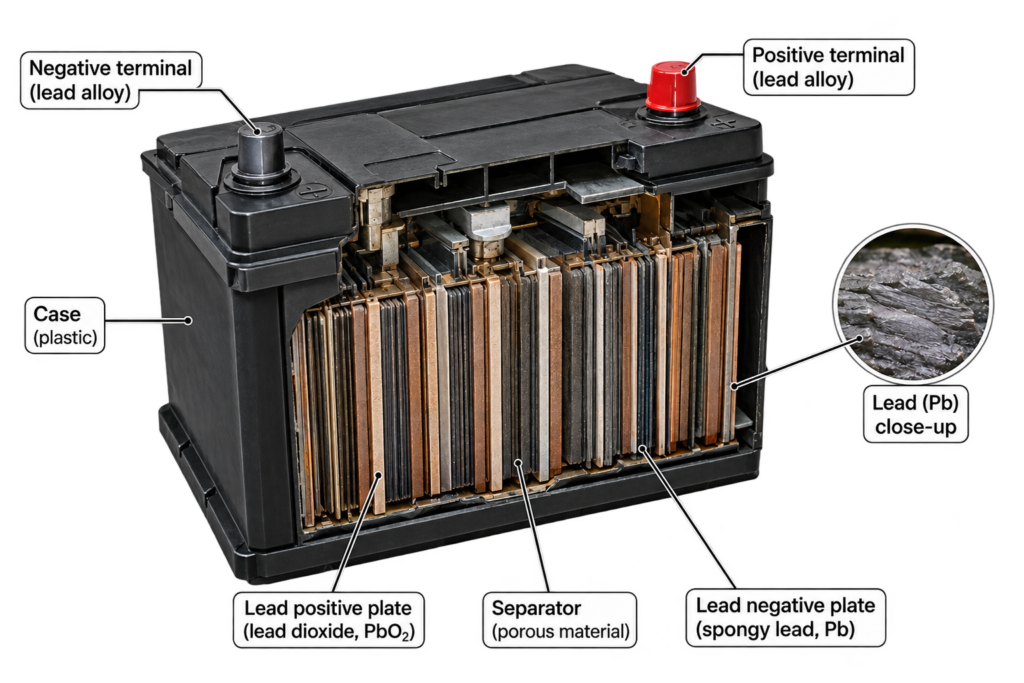
The vast majority of recycled lead goes into making new lead-acid batteries. These batteries power conventional cars, motorcycles, and commercial vehicles. They also provide backup power for data centers and hospitals. The battery recycling loop is a perfect example of circularity. Old batteries are collected and broken down. The lead plates are melted and purified.
Then, manufacturers use this secondary lead to cast new battery grids. This closed-loop system is highly efficient. However, tracking the chemistry of these batteries is complex. Manufacturers can use Digital Material Passports to record the exact composition of every new battery. This ensures high quality and full transparency.
Lead is extremely dense. This density makes it the perfect material to block harmful radiation. Hospitals use recycled lead scrap to line the walls of X-ray rooms. Nuclear power plants use lead to protect workers from radioactive materials.
Recycled lead is formed into sheets, bricks, or specialized protective clothing. Safety is the top priority in these applications. The lead must meet strict purity standards. Companies producing shielding can use material matching platforms. These platforms help them find recyclers who supply the exact grade of secondary lead they need.
Because lead is heavy, it serves as an excellent weight. Recycled lead is often cast into wheel weights for vehicles. These weights balance the tires and ensure a smooth ride. Lead is also used as ballast in ships and sailboats. It helps keep the vessels stable in rough waters.
Even scuba divers use recycled lead weights to control their buoyancy. These applications do not always require highly purified lead. Therefore, they provide a great market for lower-grade lead scrap.
The European Union takes toxic waste management very seriously. Lead is classified as a hazardous material. Mishandling lead scrap can cause severe soil and water pollution. Therefore, the EU has created strict initiatives to govern lead circularity.
One of the most important rules is the new EU Battery Regulation. This regulation aims to make all batteries sustainable throughout their life cycle. It sets mandatory targets for recycling efficiency. For lead-acid batteries, the recycling processes must achieve very high recovery rates.
Furthermore, the regulation introduces the concept of Extended Producer Responsibility. This means battery manufacturers are responsible for the end-of-life collection of their products. To comply, producers need clear data. They can utilize Digital Material Passports to trace batteries from production to final recycling. This digital trail proves compliance with EU targets.
Moving lead scrap is heavily regulated. The Basel Convention controls the cross-border movement of hazardous wastes. Companies cannot simply ship lead scrap to another country without proper documentation. They must obtain permits and prove that the receiving facility can handle the waste safely.
In the EU, the Waste Framework Directive sets the rules for safe storage and handling. Facilities must prevent lead dust from escaping. They must also treat any water used in the recycling process. Navigating these rules is difficult. Fortunately, automated software can help. By using tools for circular policy tracking, companies can stay updated on the latest toxic waste regulations across different borders.
Handling toxic materials requires precision. Manual tracking methods are no longer enough. The APT Platform provides AI-powered tools specifically designed for circularity companies. We help businesses manage lead scrap safely, legally, and profitably.
Sorting lead scrap from other metals is a critical first step. Mixing incompatible metals can ruin the recycling batch. The APT Platform uses advanced AI technology to automate this process. Computer vision models can identify different types of scrap on a conveyor belt.
Automation also extends to paperwork. Transporting toxic waste requires extensive documentation. Our AI tools can automatically generate the required shipping manifests. This reduces human error and speeds up operations. You can learn more about our automated solutions in our AI technology section.
When dealing with lead, you must know exactly where it came from and where it is going. The APT Platform features robust Digital Material Passports. These passports store the entire history of a batch of lead scrap.
The passport includes data on chemical composition, origin, and safety warnings. If an inspector arrives, the company can instantly provide all necessary information. This level of traceability is essential for meeting EU battery regulations and proving environmental compliance.
Recyclers need buyers. Manufacturers need raw materials. The APT Platform connects them. Our software includes a powerful material matching engine. It analyzes the specific qualities of a batch of recycled lead. Then, it finds the most suitable industrial buyer.
For example, highly pure lead might be matched with a medical shielding manufacturer. Less pure lead might be matched with a company making marine ballast. This ensures that every piece of scrap finds its highest-value circular application. Check out our material matching tools to see how we close the loop.
Shipping heavy, toxic lead scrap is expensive. It also carries environmental risks. The APT Platform helps companies plan the safest and most efficient transport routes. We offer advanced supply chain optimisation algorithms.
These algorithms calculate the shortest distance while avoiding restricted zones for hazardous cargo. By optimizing routes, companies save fuel and reduce their carbon footprint. Better logistics mean safer handling of toxic waste from start to finish.
To truly understand the impact of these tools, let us look at three fictional yet realistic examples. These use cases show how AI and automation help companies turn toxic lead scrap into valuable circular resources.
A company based in Germany collects thousands of end-of-life automotive batteries every month. Previously, they struggled to sort the batteries quickly. They also faced challenges reporting their recycling rates to the government. They needed a faster way to process the toxic waste and prove compliance with the new EU Battery Regulation.
The company integrated the APT Platform into their facility. First, they deployed our AI technology to visually identify and sort different battery sizes automatically. This sped up their processing time by 40 percent. Next, they implemented Digital Material Passports. As they melted down the lead plates, the system recorded the exact volume and purity of the recovered lead. When they sold the secondary lead back to battery manufacturers, the digital passport transferred with the material. The company easily proved their high recovery rates to EU regulators.
A company in France manufactures lead-lined doors for hospital X-ray rooms. They only use recycled lead to keep their carbon footprint low. However, they require a very specific, high-purity grade of lead. In the past, finding reliable suppliers of this specific scrap took weeks of phone calls and manual quality checks.
To solve this, the company joined the APT Platform. They used our material matching module to input their strict purity requirements. The AI instantly connected them with a certified lead smelter in Spain that had the exact grade in stock. To handle the complex cross-border shipment of this material, they used our circular policy tracking tools. The system automatically checked the Basel Convention requirements and generated the correct transit permits. The company received their materials on time and maintained their high safety standards for medical equipment.
A company in the Netherlands specializes in industrial demolition. They frequently recover lead roofing and lead pipes from old buildings. Transporting this toxic waste to recycling centers was a massive headache. They were spending too much money on fuel, and their trucks often faced delays at environmental inspection checkpoints.
The company decided to modernize their logistics. They adopted the APT Platform and utilized our supply chain optimisation features. The software analyzed their collection sites and the locations of nearby lead recyclers. It generated dynamic daily routes that minimized travel time and fuel consumption. Furthermore, the platform automatically attached the necessary hazardous waste documents to the digital manifest of each truck. The company cut their transport costs by 25 percent and eliminated paperwork delays entirely.
Recycling lead scrap is a complex but necessary process. It transforms a toxic hazard into an infinitely reusable resource. From powering our vehicles to protecting us from radiation, secondary lead is vital to modern society. However, the future of lead circularity relies on strict compliance and smart technology.
The European Union is setting higher standards for transparency and safety. Companies can no longer rely on outdated manual processes. By embracing digital tools, businesses can streamline their operations and stay compliant. The APT Platform is here to support that transition. With AI, digital tracking, and smart matching, we help circularity companies manage toxic waste efficiently. Together, we can build a safer and more sustainable industrial supply chain.