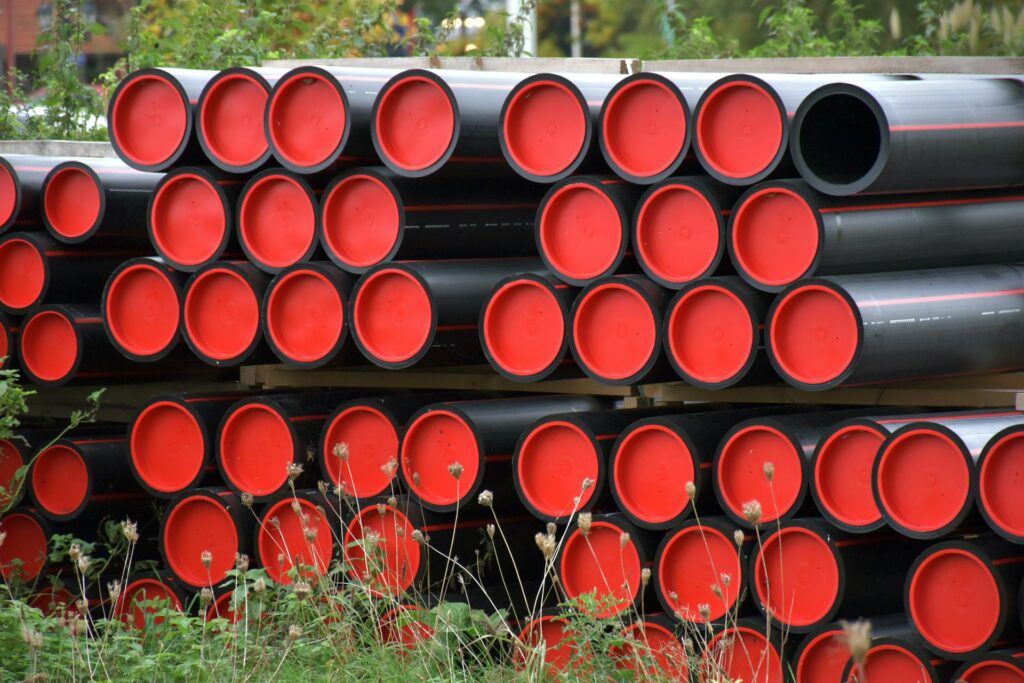
Recycled PVC applications cover a surprising range of products. The same polymer shows up in a rigid window frame, a flexible cable sheath, a roofing membrane and a garden hose. Each of those items follows a different route back into the market. Because of this, PVC is one of the harder polymers to keep in circulation, even though the material itself recycles well.
In this article we look at where recycled PVC applications sit today. We also look at the two problems that hold the sector back: legacy additives and missing data. Finally, we explain how the APT Platform uses AI-based material identification and automation to connect the right PVC stream to the right buyer, with the compliance evidence attached.
PVC is roughly half chlorine by weight, which means it needs less oil-based feedstock than most other plastics. It is also the most used plastic in European building and construction. Windows, pipes, cables, flooring and membranes all rely on it.
Those products last a long time. A window profile can stay in a facade for forty years. Therefore the material returning to recyclers today was made under the rules and recipes of the 1980s and 1990s. That single fact shapes almost everything about PVC circularity.
The volumes are real. In 2025, around 766,000 tonnes of PVC waste were recycled within the Recovinyl and VinylPlus network, which is about 5.7 percent more than the year before. Window profiles made up the largest share, followed by flooring and cables. Since 2000 the network has recycled more than 10 million tonnes. The stated goal is one million tonnes of recycled PVC used in new products every year by 2030. In other words, recycled PVC applications need to grow by roughly a quarter within five years.
PVC resin on its own is hard and brittle. Formulators turn it into a usable product by adding stabilisers, fillers, pigments, impact modifiers and, in many cases, plasticisers. The amount of plasticiser decides where a product sits on the scale from rigid to soft.
Rigid PVC contains no plasticiser or very little. Typical products include window and door profiles, drainage and pressure pipes, cable trunking, rainwater goods, wall cladding, foamed sheet and packaging film.
Semi-rigid grades sit in the middle. Think of pond liners, some conveyor components, thicker sheets and certain profile gaskets.
Flexible PVC can contain 30 percent plasticiser or more. It becomes cable insulation and jacketing, resilient flooring, coated fabrics for truck curtains and tents, roofing membranes, hoses, medical tubing, artificial leather and shoe soles.
These three groups are chemically related, but they do not mix well in a recycling line. A few percent of soft PVC in a rigid batch ruins the mechanical performance of the output. Sorting accuracy therefore drives the value of the whole chain, and it decides which recycled PVC applications a stream can reach.
Rigid streams are the backbone of the European market. Recyclers grind, sort and compound them into pellets or dry blends that converters feed straight back into extrusion lines.
Common recycled PVC applications in this category include:
Rigid recyclate competes directly with virgin resin on price. As a result, quality consistency matters more than any marketing claim. A converter needs to know the K-value range, filler load, impact modifier type and colour distribution before committing a line to it. A Digital Material Passport carries exactly those fields.
Flexible streams are more difficult, yet the applications are growing. Cable stripping operations, flooring offcuts, membrane trimmings and coated fabric waste all feed this market.
Typical recycled PVC applications for soft grades include:
Notice the pattern. Soft recyclate goes into technical, hidden or outdoor uses. It rarely goes into anything that touches food, drinking water, skin or toys. The reason has a name, and it deserves its own section.
Plasticisers make PVC soft. They are not chemically bound to the polymer chain, which means they can migrate out of the product over time. That single property creates both the technical and the regulatory headache.
Older flexible PVC often contains ortho-phthalates such as DEHP, DBP, BBP and DIBP. These four are restricted in articles under REACH Annex XVII, with a limit of 0.1 percent by weight in the plasticised material. Several are classified as toxic for reproduction and are treated as endocrine active.
In 2023 the European Chemicals Agency completed an investigation into PVC and 63 of its additives. The agency concluded that risks from the resin itself are adequately controlled under current industrial conditions. However, it recommended regulatory action on plasticisers, in particular certain ortho-phthalates, and on organotin heat stabilisers such as DOTE. It also called for better control of PVC microparticle releases, specifically at recycling sites and landfills.
Newer formulations use alternatives such as DINP, DIDP, DINCH, DOTP and citrate esters. Those alternatives carry a different and generally more favourable profile. Unfortunately, a recycler receiving mixed post-consumer material cannot tell the two generations apart by looking at them.
The problem is not only toxicity. It is uncertainty. Consider what happens in practice:
Every step in that chain is a data problem before it is a chemistry problem. In short, uncertainty closes off recycled PVC applications that the material could technically serve.
Lead stabilisers were phased out of European PVC production, but they remain in articles installed decades ago. Regulation (EU) 2023/923 amended entry 63 of REACH Annex XVII to restrict lead in PVC articles to below 0.1 percent by weight, applicable from 29 November 2024.
The regulation includes derogations that matter enormously for recyclers. Articles containing recovered flexible PVC were covered only until 28 May 2025. Specific articles containing recovered rigid PVC, such as profiles and sheets for building and civil engineering works, remain derogated until 28 May 2033, provided the recovered rigid PVC stays below 1.5 percent lead. Suppliers must also mark affected articles and, on request, show documentary evidence of the recovered origin of the material. Traceability schemes built on EN 15343 are explicitly recognised for that purpose.
Read that last sentence again. European law now treats verified traceability data as the entry ticket to a market. Recyclers who can produce that evidence keep selling. Those who cannot lose access to the derogation in practice, even though it exists on paper.
Plasticisers get the headlines, but several other barriers limit recycled PVC applications in practice.
Mixed demolition streams. PVC arrives contaminated with sealants, foam, metal, glass residue and mortar. Separation costs rise sharply with contamination.
Sorting technology limits. Near-infrared sorting struggles with black and heavily filled articles. XRF helps detect heavy metals, yet it needs to be applied at the right point in the line.
Composite construction. Laminated flooring, coated fabrics and multi-layer membranes bond PVC to textiles, foams and other polymers. Mechanical recycling then delivers a compromised output.
Long service life. A forty year lifespan is excellent for carbon footprint and terrible for feedstock planning. Today’s arisings reflect yesterday’s building boom, not today’s demand.
Price competition. When virgin resin is cheap, recyclate demand softens immediately. European recyclers reported exactly this pressure through the recent construction downturn.
Cross-border friction. Secondary PVC often needs to move between Member States to reach a converter with the right line. Waste shipment procedures under Regulation (EU) 2024/1157 add administrative time to every consignment.
Chlorine in mixed streams. PVC in a mixed plastics feed complicates chemical recycling and incineration, which is why upstream separation carries value beyond the PVC itself.
Several instruments now push in the same direction. Together they turn material data into a compliance asset, and they shape which recycled PVC applications remain open.
REACH restrictions. Entry 51 covers the four classic phthalates. Entry 63 covers lead in PVC, including the recovered material derogations described above. Further restriction work on PVC additives is under consideration following the 2023 ECHA investigation.
Ecodesign for Sustainable Products Regulation (ESPR). The ESPR creates the legal basis for the Digital Product Passport and for recycled content requirements. Delegated acts are rolling out per product group through the 2025 to 2030 working plan.
Construction Products Regulation (EU) 2024/3110. The revised CPR brings a Digital Product Passport into construction, alongside stronger environmental declarations and a clearer focus on recycled content. PVC building products sit squarely inside this scope.
Circular Economy Act. The Commission has signalled a legislative proposal in 2026 aimed at a genuine single market for secondary raw materials, end-of-waste clarity and stronger demand-side measures. The EU circular material use rate stood at 12.2 percent in 2024, against a 24 percent target for 2030, so the pressure to act is considerable.
Waste Shipment Regulation (EU) 2024/1157. This governs how secondary PVC moves across borders, including the procedures and documents required for each consignment.
Industry commitments. VinylPlus and Recovinyl provide the audited monitoring layer, including recycled tonnage verification and traceability certification aligned with EN 15343.
APT Platform was built for exactly this kind of problem: a valuable material blocked by missing, scattered or unverifiable data. Our approach combines AI classification, structured material data and workflow automation.
Users describe a stream in plain language or upload their existing records. The platform maps that description to the correct material category, suggests the likely European Waste Catalogue code and flags the properties a buyer will ask about. For PVC that means hardness class, plasticiser status, stabiliser history, colour distribution, expected contamination and origin sector.
The Digital Material Passport, or DMP, holds the evidence in one structured record. Analytical results, XRF screening for lead and cadmium, phthalate test reports, EN 15343 traceability certificates, photographs and batch history all live together. Consequently a converter reviewing an offer sees the compliance position immediately rather than after three weeks of email.
The DMP also carries forward. When a recycler ships a batch, the passport travels with it. When the converter later needs to prove the recovered origin of the PVC to an enforcement authority, the record already exists.
Our matching module works across a detailed material taxonomy rather than broad headings. A soft PVC cable compound with confirmed alternative plasticisers reaches buyers with the right specification. A rigid profile regrind with a known lead legacy reaches buyers working inside the 2033 derogation. Meanwhile, applications that cannot accept that material never see it, which saves everyone time.
Cross-border movement generates paperwork. The platform automates the document set, checks the control regime that applies to a given code and route, and keeps the file complete. In addition, users get a clear view of which restriction thresholds apply to the intended application before the sale is agreed.
The following scenarios are illustrative composites. They describe realistic situations rather than named customers.
A contractor in Noord-Brabant strips 1990s window frames from a housing renovation. The profiles are white, dusty and full of steel reinforcement, gaskets and hardware. Two converters decline the load because nobody can confirm the lead content.
The contractor logs the stream in APT. AI classification identifies it as post-consumer rigid PVC-U profile from building and construction, assigns the code and lists the tests a converter will require. The team runs XRF screening at a suggested sampling frequency and uploads the results into the Digital Material Passport, together with the building records that establish the installation period.
The passport shows lead below the 1.5 percent threshold. Matching then routes the offer to a German profile extruder that operates a co-extrusion line for concealed core layers. Because the derogation conditions are documented in advance, the buyer accepts the batch, and the marking obligation is handled at the point of manufacture rather than discovered later.
A Belgian cable recycler produces around 40 tonnes a month of PVC jacketing granulate. Roughly a third comes from recent installation waste with modern plasticisers. The rest comes from stripped legacy cable of unknown vintage. Blended together, the whole volume becomes unsellable to quality-sensitive buyers.
The recycler uses APT to split the stream into two documented grades instead of one uncertain one. Each grade gets its own passport with analytical evidence and origin data. The AI assistant highlights which applications each grade can legally serve.
The modern fraction goes to a producer of acoustic underlay who needs consistent input. The legacy fraction goes to a manufacturer of cable protection tiles and traffic products, where the exposure profile is different and the specification allows it. Two clean markets replace one blocked one, and the recycler stops discounting good material to cover unknown risk.
A Polish converter of PVC-coated polyester membranes generates a steady flow of production offcuts. The material is clean, traceable and free of legacy additives. However, it is a composite, so standard mechanical recycling delivers poor results and local buyers offer very little.
The converter publishes the stream on APT with full formulation data in the Digital Material Passport, including plasticiser type and textile content. Matching surfaces two options the converter had not considered: a Dutch manufacturer that reuses large panels for industrial covers and bags, and an Italian processor that grinds coated fabric into a filled compound for mats and heavy-duty profiles.
Both buyers sit in other Member States. The platform generates the waste shipment documentation, identifies the applicable control regime and tracks the notification status. As a result, the converter turns a disposal cost into two recurring supply relationships, with the paperwork handled as part of the workflow.
If you handle PVC anywhere in the chain, three practical steps improve your position immediately.
European legislation is moving from general recycling targets towards verified, product-level material data. PVC sits at the front of that shift because its legacy additives make traceability unavoidable. Recyclers and converters who build that evidence now will hold a commercial advantage as the Digital Product Passport rules take effect.
Recycled PVC applications exist for almost every grade, from rigid profile regrind to soft cable compound. The barrier is rarely the polymer. It is the missing evidence that would let a buyer say yes.
APT Platform brings that evidence together and connects your material to the recycled PVC applications that can use it. Contact our team to discuss your PVC streams, or explore how the Digital Material Passport works across other material chains.