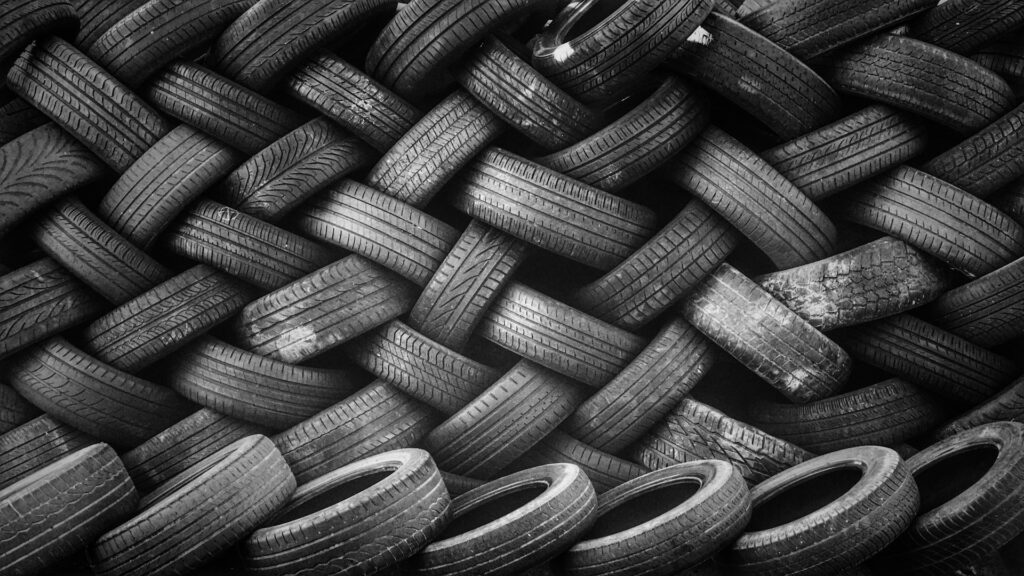
Europe has effectively solved the tyre collection problem. Extended producer responsibility schemes now cover most member states, and the tyre value chain reports a treatment rate of around 97 per cent, with material recovery climbing from roughly 10 per cent to 60 per cent over twenty-five years. Roughly 3.9 million tonnes of end-of-life tyres were collected for treatment in 2024. About half of that volume is recycled into rubber, steel and textile fractions. The other half is co-incinerated in cement kilns, and up to a third of all treatment happens outside Europe.
The open question in end-of-life tyre recycling today is how to find the best business deals that ensure a quality supply, premium profit, and optimal material utilisation. The spread between the best and worst destinations for the same tonne of rubber is wide enough to determine whether a production line investment is feasible.
This article walks through the applications that end-of-life tyre recycling currently serves, summarises them in a single table, and sets out where an AI and automation layer changes the economics.
A tyre is a composite of rubber compounds, steel cord and bead wire, and textile reinforcement. Mechanical processing shreds, granulates and mills the rubber into shreds, chips, granulates, and fine powder, liberating steel and textile along the way. Thermochemical processing, principally pyrolysis, decomposes the rubber in the absence of oxygen into recovered carbon black (rCB), tyre pyrolysis oil (TPO), non-condensable gas and a recoverable steel fraction.
Each fraction has its own buyer, its own specification and its own regulatory exposure. They are worth taking one at a time.
Granulate is mainly used as infill for synthetic turf. It also goes into moulded and bonded goods: safety and playground tiles, terrace and roof tiles, anti-vibration pads, acoustic underlays, damping layers under tram and rail track, livestock mats, and a long tail of consumer goods. Fine powder feeds compound blending and asphalt modification.
However, granular infill for synthetic sports surfaces may no longer be placed on the market from 17 October 2031 after an eight-year transition, due to Commission Regulation (EU) 2023/2055. EuRIC has estimated that recycled rubber accounts for roughly 80 per cent of infill in use. Existing pitches can live out their service life, but the sales channel closes. Every recycler currently sending granulate into that channel has a finite window to develop replacement demand in construction, moulded goods and asphalt, and the ones that move early will be selling into a market that has not yet been flooded.
For those use cases, rubber granulate is treated as a mixture under REACH entry 28 rather than an article under entry 50, and the Dutch scheme RecyBEM requires its certified recyclers to hold the sum of eight PAHs below 20 mg/kg, a materially tighter limit than the law requires. A load that cannot evidence its polycyclic aromatic hydrocarbon profile is unsellable.
Adding fine crumb rubber to bitumen produces a binder with better elastic recovery, improved resistance to cracking and rutting, and lower rolling noise. Ecopneus reports more than 670 lane-kilometres of rubberised asphalt laid in Italy, with acoustic monitoring showing traffic noise reductions in the range of 3 to 5 dB. Spain, through SIGNUS, has built up roughly 1,600 kilometres. One documented Italian intervention, the Canali bypass at Reggio Emilia, avoided over 40 tonnes of CO2 and around 70,000 kWh of energy compared to a conventional comparison.
The technology is mature, but effective procurement is a major limitation. Road authorities would specify crumb rubber only if the buyer is confident that consistent gradation, moisture content, and contaminant levels will be available throughout the contract. That is a supply-chain data problem sitting in front of a civil engineering opportunity.
Devulcanisation breaks sulphur crosslinks so that recovered rubber can re-enter compound formulations rather than being confined to bonded products. The University of Twente developed a chemical devulcanisation route for tyre granulate, and several European processors now sell reclaim into technical rubber goods. Blend ratios in demanding applications remain modest, so this is a high-value, low-volume outlet for now. It is also the route most sensitive to feedstock consistency, because a devulcanisation line tuned for passenger car tread will not behave the same way on mixed truck casings.
Pyrolysis receives significant capital. rCB substitutes for a share of virgin furnace black in tyres, technical rubber goods, hoses, seals and pigments. TPO is fed into steam crackers alongside fossil naphtha, and the recycled content is allocated to downstream products such as butadiene and styrene under ISCC PLUS mass balance accounting.
ETRMA has historically been cautious about pyrolysis economics, noting that by-product prices often failed to justify process costs. That has changed for a specific reason: plants are now being financed against multi-year offtake agreements signed before commissioning rather than against spot markets. This matters more than it sounds. When a facility is built on pre-sold output, feedstock specification stops being an operational nuisance and becomes a financing condition. A pyrolysis operator who cannot guarantee input consistency cannot guarantee output consistency and cannot sign the contract that funds the plant.
Liberated steel cord is clean and goes to electric arc furnaces and foundries. It is the least troublesome fraction commercially and the one most often undersold, because it is frequently bundled into the gate fee rather than priced as the alloy scrap it is.
Textile fibre is the weakest link. Recovered nylon and polyester fluff is contaminated with rubber dust, low in bulk density and expensive to transport. Some goes into fillers, insulation boards and cement kiln fuel. Most of the value engineering in end-of-life tyre recycling over the next decade will happen here, because it is the only fraction where the current default is close to disposal.
Cement kiln co-processing consumes whole or shredded tyres as tyre-derived fuel, substituting for coal and petcoke while the steel is absorbed into the clinker. It has near-unlimited capacity and functions as the floor price for the whole system. Every tonne that goes to incineration should be considered a failure of the material recovery routes that failed to bid for it. This usually because nobody has a functional supply chain from end-of-life tyres to product.
The bottleneck in end-of-life tyre recycling sits in the measurable, batch-specific, and cleanly recorded specification. Unfortunately, sorting decisions made at the gate determine the value of everything downstream, and they are usually made visually and quickly by whoever is on shift.
Documentation and fragmented end-of-waste status contribute to broader issues. End-of-life tyres carry EWC code 16 01 03, and processed rubber fractions typically move under 19 12 04. Cross-border movement inside the EU falls under Regulation (EU) 2024/1157 on shipments of waste, with its notification and Annex VII regimes. Given that a substantial share of European ELT treatment happens outside the EU, this paperwork is not an edge case for most operators; it is the daily job. EuRIC and ETRMA have jointly pushed for harmonised EU end-of-waste criteria for ELT-derived rubber precisely because the current patchwork means the same granulate is a product in one member state and a waste in another, with the transport and permitting burden that implies.
Finally, mass balance schemes such as ISCC PLUS only work if the chain of custody holds from collection point to cracker. A tonne of TPO with an incomplete provenance record cannot carry a certified recycled content claim, which removes the premium that justified the pyrolysis investment in the first place. The forthcoming Digital Product Passport regime under ESPR will extend this logic from voluntary certification to regulatory obligation.
APT Platform exists to close that gap between physical material and verifiable data. Applied to tyre streams, the four modules do specific work.
The Visual AI Engine turns the gate inspection into a data capture event. A yard operator photographs an incoming load with a standard smartphone and the model returns a material assessment: casing type and likely construction, visible contamination, foreign objects, and an estimate of the fractions the load will yield. No lab, no handheld spectrometer, no specialist. The point is not to replace laboratory testing where a buyer requires it, but to make sure every load is characterised at the moment when a routing decision is still possible.
The Digital Material Passport attaches that assessment, plus subsequent test results, to the batch as a tamper-evident record that travels with the material. For a granulator selling into safety flooring, this is where the PAH certificate stops being an email attachment and becomes an attribute of the goods. For a pyrolysis operator, it is where feedstock provenance becomes auditable against a mass balance claim.
The Matching Module uses that structured data to find the outlet, rather than defaulting to the buyer who called last week. This is where the value spread gets captured. If a load is clean truck casing with high steel content, the system should be pricing the steel fraction properly and routing the rubber to a rCB producer rather than to a kiln.
Automation generates the transport and compliance documents from the passport data: EWC classification, Annex VII forms, notification dossiers where required, and the commercial paperwork from quotation through to invoice. Anyone who has assembled a waste shipment file by hand knows how much of the working week that reclaims. Supply chain optimisation then sequences logistics against the processing capacity actually available.
| ELT fraction and outlet | What the buyer requires | Where value leaks today | APT module in play | What APT changes |
|---|---|---|---|---|
| Rubber granulate (1 to 4 mm) for safety tiles, livestock mats, acoustic underlay, moulded goods | Particle size distribution, PAH profile below buyer-specific limits, steel and textile residue, bulk density | PAH certificates live in email threads and cannot be tied to the delivered batch, so compliant material is priced as if it were unverified | Digital Material Passport, Matching Module | Test data becomes an attribute of the batch rather than a separate document, so quality can be priced and defended at the point of sale |
| Rubber powder (below 1 mm) for asphalt modification and compound blending | Gradation curve, moisture, ash content, consistency across an entire supply contract | Road authorities will not write crumb rubber into a multi-year specification without evidence of consistency they cannot currently obtain | Digital Material Passport, Supply Chain Optimisation | A continuous, batch-level quality record that a procurement body can audit, which is the precondition for being named in a tender |
| Devulcanised reclaim for technical rubber goods | Narrow feedstock consistency, known casing type, predictable polymer profile | Devulcanisation lines tuned for passenger tread underperform on mixed truck casings, and the mix is often unknown until processing | Visual AI Engine, Matching Module | Casing type and construction identified at intake, so feedstock is segregated toward the line that can actually process it |
| Recovered carbon black for tyre and technical rubber compounds | Ash, sulphur, structure and surface area, and auditable feedstock provenance behind every batch | Offtake agreements now carry feedstock conditions, and suppliers who cannot evidence input consistency are pushed to spot volumes | Visual AI Engine, Digital Material Passport | Verifiable provenance from collection point to reactor, which converts a spot seller into a candidate for a multi-year supply agreement |
| Tyre pyrolysis oil for steam cracker feedstock | Sulphur, chlorine, water, distillation profile, and chain of custody sufficient for ISCC PLUS mass balance | An incomplete provenance record removes the certified recycled content claim, and with it the premium that justified the plant | Digital Material Passport, Automation | Tamper-evident chain of custody assembled automatically as material moves, aligned with mass balance and forthcoming DPP requirements |
| Steel cord and bead wire for EAF steelmaking and foundries | Rubber residue, bale density, tramp elements | Routinely absorbed into the gate fee instead of being sold as graded alloy scrap, so the fraction earns nothing of its own | Visual AI Engine, Matching Module | Steel content estimated at intake and matched to steel buyers as a separately priced stream rather than a processing by-product |
| Textile fibre for fillers, insulation and kiln fuel | Rubber contamination, moisture, fibre length | Rarely characterised at all, so it defaults to the lowest-value outlet available by habit | Visual AI Engine, Matching Module | Characterisation at near-zero marginal cost makes it worth testing whether a buyer exists, which is currently never established |
| Whole and shredded tyres for cement kiln fuel and civil engineering fill | Calorific value, wire content, size consistency, complete shipment documentation | Cross-border movement under Regulation (EU) 2024/1157 consumes days of administrative work per consignment | Automation, Supply Chain Optimisation | EWC classification, Annex VII forms and notification dossiers generated from passport data, with logistics sequenced against real processing capacity |
| The load as it arrives at the gate (mixed passenger, truck, agricultural, OTR, retreadable) | A routing decision made in the first hour that determines every downstream price | Sorting is done visually and quickly by whoever is on shift, and a wrong call is irreversible once the material is granulated | Visual AI Engine, Matching Module | A smartphone photo returns casing type, contamination and expected fraction yields before the routing decision is locked in |
How to read this table. The first three columns describe the market as it operates now, independently of any platform. The last two describe where an identification, traceability and automation layer intervenes. The pattern across every row is the same: the physical processing is mature and the chemistry is well understood, while the price a fraction achieves is set by whether its properties can be evidenced at the moment a decision is made.
Three practical moves follow for anyone running an end-of-life tyre recycling operation.
Characterise end-of-life tyres immediately, wherever and whenever possible. The routing decision that determines whether a load earns kiln fuel prices or rCB feedstock prices happens in the first hour, and it depends entirely on information available at that moment.
Treat the characterisation data as an attribute of the batch and demonstrate it with an attached passport. If PAH results, gradation curves and moisture readings live in a separate folder, do not travel with the goods; they cannot be used to defend a price.
Move now to replace the demand for infill volume now. Six years may sound like a long time, but finding new application channels could easily take longer.
APT is currently in pilot deployment with founding partners, and tyre streams are a natural fit precisely because the material is high volume, chemically well understood, and held back almost entirely by information friction rather than by technology.
If you operate a collection, granulation or pyrolysis business and want to see how AI-based identification and automated documentation apply to your streams, get in touch with the APT team or explore the Matching platform. Our regulatory strategy hub tracks how ESPR, the Digital Product Passport and the Waste Shipment Regulation are reshaping obligations across these value chains.
Sources and further reading: Tyres Europe / ETRMA on ELT circularity | EuRIC on harmonised end-of-waste criteria | Commission Regulation (EU) 2023/2055 | Infiniteria | BASF on the tyre-to-tyre partnership | Ecopneus on modified asphalts