Two European laws landed within a single week this August. The Packaging and Packaging Waste Regulation started to apply on 12 August 2026. The End-of-Life Vehicles Regulation entered into force on 13 August 2026. Both create binding legal demand for recycled polypropylene. European PP recycling capacity, however, has barely moved since 2023.
That mismatch shapes every conversation about recycled polypropylene applications right now. There is no shortage of buyers. There is a shortage of PP recyclate that a buyer can specify, verify and defend to an auditor.
This article looks at where recycled polypropylene actually goes today. It sets out the EU rules that now govern those outlets. It then shows how the APT Platform uses AI and automation to connect a specific PP stream to a specific buyer, with the evidence attached.
Polypropylene accounts for roughly 19 to 20 percent of all plastics converted into products in Europe. It is the second most produced commodity polymer after polyethylene. It survives repeated extrusion cycles well. On paper, PP should be an easy material to recycle.
In practice, “PP” is not one material. It is a family of thousands of commercial grades. Three base types dominate:
On top of that sit fillers. Automotive PP is often talc filled at 20 to 40 percent. Some grades carry glass fibre, calcium carbonate or elastomer modifiers. Melt flow index ranges from below 1 to above 100 grams per ten minutes. A crate moulder and a fibre spinner cannot use the same recyclate.
Polypropylene has a density of about 0.90 to 0.91 grams per cubic centimetre. HDPE sits at 0.94 to 0.96. Both float in water. Sink and float separation alone therefore does not cleanly split the two polyolefins.
Near infrared sorting does separate PP from PE reliably. What NIR cannot do is separate grade from grade. It cannot tell a talc-filled bumper fragment from an unfilled yoghurt pot. It also struggles with black items and with multilayer parts.
The result is predictable. Most post-consumer PP arrives at the recycler as a mixed rigid stream. It leaves as a grey or off-white pellet with a wide property band. That pellet fits some applications and fails others.
Recycled polypropylene is sold in several forms. Regrind or flake is the cheapest. Pellets are the standard tradable form. Compounds carry added fillers, impact modifiers and stabilisers to hit a target specification. Each form suits different outlets.
Automotive is the largest single volume outlet for compounded recycled polypropylene in Europe. Typical parts include wheel arch liners, underbody shields, battery trays, air ducts, cable ducting, boot liners and sill covers.
These applications tolerate recyclate well. Colour is usually black or hidden. Talc-filled impact copolymer grades absorb property variation better than unfilled grades. Odour and emission limits still apply for interior parts, tested to methods such as VDA 270 and VDA 278.
The End-of-Life Vehicles Regulation turns this outlet from a cost decision into a compliance one. Carmakers now need documented recycled content, not just cheaper material. That shifts the burden onto suppliers, and from suppliers onto recyclers. Verified traceability data becomes part of the product, which is exactly what a Digital Material Passport is built to carry.
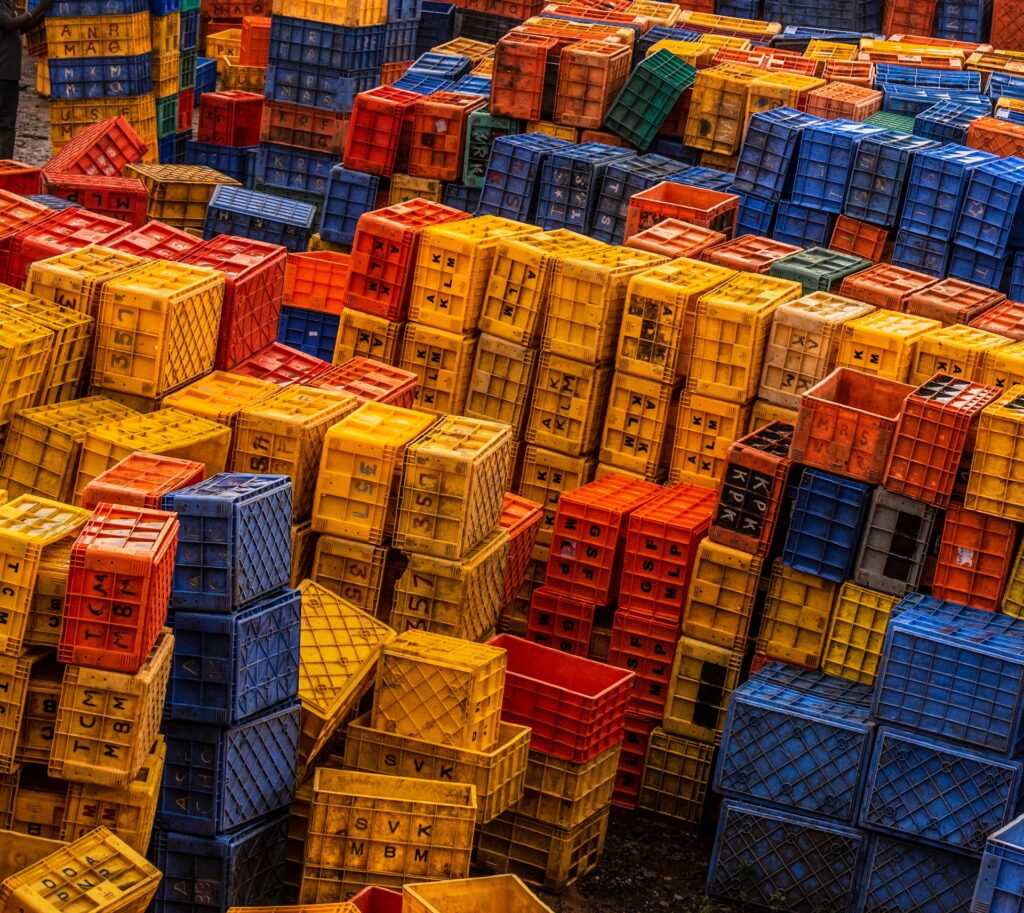
Crates, pallets, dollies, bins, drums and intermediate bulk container components are the most reliable home for rPP in Europe. Volumes are large and specifications are forgiving.
Three factors help. Colour is rarely critical, since most pooled equipment is dark. Wall sections are thick, so impact variation matters less. Many pools are closed loop, so the same crates come back after five to ten years of service.
Post-industrial PP from moulders often goes straight into this outlet. Post-consumer rigid PP does too, usually blended with virgin material at 30 to 70 percent.
Construction absorbs large tonnages of lower grade recycled polypropylene. Common uses include drainage pipe fittings, cable protection ducts, formwork accessories, reinforcement spacers, geotextiles and PP fibres for concrete reinforcement.
Service lives here run for decades. Aesthetic requirements are low. What matters is a stable mechanical specification and freedom from restricted substances. For a recycler, construction is often the outlet that clears mixed grey material at a workable price.
Buckets, storage boxes, paint pails, garden furniture, tool housings, brush bodies and cleaning products all use recycled polypropylene. This is where colour starts to matter commercially.
Natural or near-white rPP, mostly from clear packaging and caps, carries a clear price premium. Grey rPP is restricted to dark or opaque products. That single distinction can move the value of a load by several hundred euros per tonne.
Polypropylene is a major fibre polymer. Recycled polypropylene feeds strapping, rope, carpet backing, big bags, geotextiles and some non-woven products.
Strapping is a notable outlet, because it tolerates a wide melt flow band. Non-woven medical and hygiene PP remains a persistent gap. It is collected in small volumes, contaminated, and rarely worth separating.
Food-contact is where recycled polypropylene applications hit a hard regulatory wall. Under Regulation (EU) 2022/1616, recycled plastic for food contact may only be produced by an authorised recycling process.
Post-consumer mechanical PET is currently the only recycling technology formally recognised as suitable. Mechanical rPP has to go through the novel technology route instead. Developers register a technology, EFSA assesses it, and individual processes are then authorised. As of March 2026, the EU register listed 24 novel technologies in development, covering rPP, rHDPE and rPS among others.
Some food-grade rPP is already on the market from decontamination-based processes. Volumes remain in the tens of thousands of tonnes. Demand under PPWR could approach one million tonnes by 2030. For now, most rPP therefore serves non-food applications.
The Packaging and Packaging Waste Regulation entered into force on 11 February 2025 and applies from 12 August 2026. It replaces Directive 94/62/EC and applies directly in all 27 member states.
From 1 January 2030, minimum recycled content targets apply to plastic packaging:
| Packaging category | 2030 | 2040 |
|---|---|---|
| Contact-sensitive packaging, PET as main component | 30% | 50% |
| Contact-sensitive packaging, plastics other than PET | 10% | 50% |
| Single-use plastic beverage bottles | 30% | 65% |
| All other plastic packaging | 35% | 65% |
Most PP packaging falls in the last row. That 35 percent target is the single largest new demand driver for recycled polypropylene in Europe. Recyclability grading also starts in 2030, and only grades A to C may be placed on the market from that date.
The ELV Regulation was published on 24 July 2026 and entered into force on 13 August 2026. It applies two years later. It replaces the 2000 ELV Directive and the 3R type-approval Directive.
The recycled content rules matter directly for PP, because plastic in a vehicle is mostly polypropylene:
Chemical recycling can contribute through mass balance accounting. The Commission must adopt an implementing act on verification methods within 24 months. Until then, buyers will demand documentary evidence from their suppliers, and they will keep it.
Directive (EU) 2019/904 has required tethered caps on single-use beverage containers up to three litres since 3 July 2024. Those caps are almost always polypropylene. Tethering keeps the cap with the bottle through the return system.
PPWR then requires member states to collect at least 90 percent of single-use plastic bottles by 2029, mostly through deposit return schemes. Together, these two rules are quietly building the cleanest post-consumer PP stream in Europe.
The Commission is expected to table a Circular Economy Act in late 2026. Its stated aim is a single market for secondary raw materials. Likely elements include harmonised end-of-waste criteria, reform of extended producer responsibility, and measures to stimulate demand for recycled content.
For PP traders, harmonised end-of-waste is the point to watch. Today a washed PP flake can be a product in one member state and a waste in the next. Our circular policy hub tracks these files as they develop.
Regulation (EU) 2024/1157 governs cross-border movement. Most clean PP scrap moves under green-listed controls with an Annex VII document. Mixed or contaminated loads can fall under notification. Getting that classification wrong stops trucks at the border.
The demand side is now legally fixed. The supply side is not keeping pace.
Plastics Recyclers Europe and ICIS reported installed PP recycling capacity of 1.8 million tonnes across the EU27+3 in 2023, with HDPE at 1.7 million tonnes and roughly 300 facilities in total. Capacity plateaued that year after a decade of growth.
The collection picture is worse than the capacity picture. In 2023, about 13.3 million tonnes of rigid HDPE and PP were placed on the European market. Only around 2.7 million tonnes of rigid material reached recyclers as sorted input. That is roughly 42 percent of what was collected.
Meeting PPWR targets will require an additional 2 million tonnes of rigid HDPE and PP recycling capacity by 2030, and a further 5.7 million tonnes by 2040. The European Commission estimates that only about 13 percent of EU plastic is currently recycled into new plastics.
Capacity investment is part of the answer. Information is the other part, and it is cheaper to fix. A great deal of usable recycled polypropylene feedstock is landfilled, exported or burned simply because nobody could describe it accurately enough for a buyer to say yes.
APT Platform is built for exactly that problem. It combines material identification, structured data, matching and document automation in one workflow. Four capabilities do the work.
Visual AI identification. The Visual AI Engine identifies material from photographs taken at the bunker, the bale press or the weighbridge. It classifies polymer type, flags visible contamination and proposes the applicable European Waste Catalogue code. An operator gets a first-pass classification in seconds instead of waiting for a lab slot.
Structured material records. The Digital Material Passport turns those observations into a record a buyer can read. Polymer, grade family, melt flow band, filler content, ash, colour split, origin, EWC code and test results sit in defined fields. The passport travels with the batch.
Matching. The Matching Module compares that record against live demand across Europe. Instead of one broker’s contact list, a recycler sees which buyers can actually accept the grade in hand. Offers and requests are published on the APT matching platform.
Document automation. Administrative document automation prepares the paperwork that follows the material. Annex VII forms, waste stream numbers, declarations of conformity and transport documents are drafted from the same data the passport already holds. Route and batch optimisation then works out how to move it economically.
The three cases below are fictional. The material types, volumes, grades and regulatory steps are realistic and reflect situations European operators face every week.
Maasveld Kunststoffen is an injection moulder near Roermond producing horticultural trays and crate components. It generates about 340 tonnes a year of purge, sprues and rejected parts under EWC code 07 02 13. Today the whole lot goes to a broker as mixed regrind at a flat price.
The mix is not actually uniform. Roughly 200 tonnes is natural unfilled PP-H with a melt flow index between 12 and 25. The remainder is talc-filled black impact copolymer from a second production line.
The plant photographs each collection bin. The Visual AI Engine separates the two families and flags a small stream of PA-containing rejects that must be kept out. The Digital Material Passport records the melt flow band, filler content and colour split for each fraction, with the batch weights from the weighbridge.
Matching then does its work. The natural fraction goes to a housewares moulder in North Rhine-Westphalia that needs light-coloured rPP. The filled black fraction goes to a crate producer in Belgium. Two buyers, two prices, one stream that used to be sold as one grade. Document automation prepares the Annex VII forms for both shipments, and route optimisation groups them into one collection run.
Recuperacions Ponent is a sorting facility in Catalonia handling household rigid plastics. Its rigid PP fraction, EWC 19 12 04, runs at about 900 tonnes a month. Two automotive compounders have expressed interest, then withdrawn after trial loads showed inconsistent polyethylene and polystyrene carry-over.
The problem is not the sorting line. It is the absence of evidence. The plant knows its output is usually good. It cannot prove it bale by bale.
Cameras on the outfeed feed images to the Visual AI Engine. Every bale receives a composition estimate and a contamination flag before it is wrapped. Those readings, plus monthly laboratory results for melt flow, ash and impact strength, build into a rolling Digital Material Passport with a visible variance band.
The compounder in Czechia can now see the spread, not just an average. It contracts for the talc-tolerant fraction at a fixed monthly volume, with a rejection clause tied to the recorded variance. Because the passport records post-consumer origin, the compounder can also count the material towards its own recycled content reporting under the ELV Regulation.
Kaptura Recykling processes bottle caps and closures returned through deposit schemes in Silesia. Output is a clean natural rPP with a melt flow index of 8 to 12 and low ash. This is among the most valuable rPP available in Europe.
Two problems slow the business down. First, buyers in Italy and Germany want proof of post-consumer origin and collection route before they will pay the premium. Second, each cross-border shipment needs correct classification and paperwork under Regulation (EU) 2024/1157, and the team was preparing it manually.
The Digital Material Passport captures the collection route from the deposit scheme through to the wash line, with the relevant EWC codes at each step. Buyers see provenance rather than a claim in an email. That is the difference between a spot sale and an annual contract.
Administrative document automation handles the rest. Annex VII forms are generated from the passport data, checked against the classification rules for both destination countries, and issued with the transport documents. Preparation time for each shipment drops from a working morning to a few minutes. The team ships to three countries with the same staffing.
Practical steps that do not require capital investment:
Can recycled polypropylene be used in food packaging in the EU? Only if the recycling process is authorised under Regulation (EU) 2022/1616. Post-consumer mechanical PET is currently the only technology formally recognised as suitable. Mechanical rPP must follow the novel technology route, with EFSA assessment. Some authorised decontamination processes exist, but volumes remain small.
How much recycled content will PP packaging need? Under PPWR, most plastic packaging needs 35 percent recycled content from 1 January 2030, rising to 65 percent from 2040. Contact-sensitive packaging made from plastics other than PET needs 10 percent from 2030 and 50 percent from 2040.
Which applications pay the most for recycled polypropylene? Natural or near-white pellets for housewares, cosmetics and consumer goods usually command the highest price, because colour freedom is scarce. Compounded automotive grades pay well but demand tight specifications and documented origin. Construction and transport packaging clear volume at lower margins.
The regulatory demand for recycled polypropylene applications is now written into law, with dates attached. The material exists. What is missing between the two is a reliable description of what a given load contains and where it came from.
That is a data problem, and data problems are solvable faster than capacity problems. If you handle PP streams and want to see how this works with your own material, get in touch with the APT team.